
Home » Posts tagged 'Donald Trump' (Page 19)
Tag Archives: Donald Trump

10 takeaways from the first Democratic 2020 debate
Donald Trump draws surprisingly little fire; Texan Julián Castro has breakout performance
♦By Rich Shumate, ChickenFriedPolitics.com editor
 MIAMI (CFP) — The first 10 Democrats took the stage in Miami Wednesday night for the first of two nights of debate among the more than two dozen candidates running for their party’s 2020 presidential nomination. Here’s a recap of some of the key takeaways from the proceedings.
1. Life at the Top: U.S. Senator Elizabeth Warren of Massachusetts was the only one of the candidates in the top five in national polling to take the stage in the first debate, and she got pride of place to both open and close the proceedings. She made the most of her moments and avoided taking shots from the other candidates, although there was long stretches in the second half of two-hour debate where she faded out of the conversation. Her best moment came when she was asked if she had a plan as president to deal with Senate Majority Leader Mitch McConnell, and she responded, “I do” — then made a few fiery comments about energizing Democrats “to make this Congress reflect the will of the people.”

Former San Antonio Mayor Julián Castro has breakout performance at first Democratic debate (From MSNBC)
2. Breakout Performance: Among the candidates further back in the pack, the breakout performance of the night may have come from former San Antonio Mayor Julián Castro, one of two Southerns in the race, who got quite a bit of screen time and dominated the immigration portion of the debate, on a day when the crisis at the U.S.-Mexico border dominated the news cycle. As the only Latino in the 2020 race, Castro spoke with authority that other candidates were hard pressed to match.
3. Private Insurance Fault Line: When the candidates were asked if they supported creating a Medicare-for-all system that would abolish private insurance that employees receive from their employers, only two candidates — Warren and New York Mayor Bill DeBlasio — raised their hands, although both former U.S. Rep. Beto O’Rourke of Texas and U.S. Senator Cory Booker of New Jersey indicated they supported versions of Medicare-for-all that stopped short of ending private insurance. The greatest pushback on the idea came from former U.S. Rep. John Delaney of Maryland: “I think we should be the party that keeps what’s working and fixes what’s broken.”
4. Texas Immigration Tangle: Castro called for repeal of the section of federal law that makes it a crime to illegally cross the U.S. border, which he said had been used by the Trump administration to target migrants. Then he tried repeatedly to get O’Rourke and the other candidates on the stage to follow his lead — and interrupted O’Rourke as he tried to explain his immigration policy without taking a position on repeal, in what proved to be one of the few direct confrontations of the evening.
5. Personal Touch: In discussing issues brought up by the moderators, O’Rouke tried to set himself apart from his competitors by inserting personal stories of Americans whom he has met on the campaign trail and other anecdotes into his responses. This approach perhaps reached its nadir when he was asked if his Justice Department would pursue charges against President Donald Trump once he left office — and he launched into a non sequitur about a painting in the U.S. Capitol that shows George Washington resigning his commission as head of the army.
6. Biggest Threat? When candidates were asked who or what they thought presented the biggest threat to the United States, most said China or climate change. Only one — DeBlasio — said Russia “because they’re trying to undermine our democracy.” But Washington Governor Jay Inslee triggered a cascade of applause with his answer: “Donald Trump.”
7. A Different Kind of Democrat? Three of the candidates mired near the bottom in national polls tried to set themselves apart by portraying themselves as a different kind of Democrat. U.S. Rep. Tim Ryan of Ohio called for the party to pay more attention to blue collar voters in the Midwest, saying its center of gravity needed to shift away from coastal elites. Delaney issued a call for pragmatism, saying Democrats needed to adopt “real solutions, not impossible promises.” And U.S. Rep. Tulsi Gabbard of Hawaii, an Iraq War veteran and major in the Army National Guard, called for a complete U.S. pullout from Afghanistan, saying “we are no better off in Afghanistan today than we were when we began.”
8. Mayor Pushy: DeBlasio did his best to live up to the stereotype of New Yorkers as loud and obnoxious, frequently interrupting the proceedings and interjecting himself at high volume. He gave several lectures on how Democrats need to represent working people and invoked his biracial son to make a point about police reform. True, he got noticed among the flash mob on the stage, but probably not for the right reasons.
9. Where’s The Donald?: With the notable exception of Inslee’s line about Trump being the nation’s biggest existential threat, the Democrats spent surprisingly little time during the debate directly castigating the president — despite the fact that the 2020 election is shaping up as a referendum on the incumbent and the Democratic base sees the president in a slightly less favorable light than Satan.
10. Winners and Losers: Among the evening’s winners were Warren, who needed to get through the debate without stumbling and made a case that she can take on Trump, and Castro, who perhaps put himself back in the national conversation. The losers included DeBlasio, who came off as wild, goofy and unlikable, and O’Rourke, whose vague and often rambling responses couldn’t disguise the fact that he generally wasn’t answering the moderators’ questions. If his ardent supporters were looking for the debate to push him to the front ranks of the race, they’re probably going to be disappointed.
We tweet @ChkFriPolitics Join us!
GOP’s Alabama headache returns: Roy Moore running for U.S. Senate
Former chief justice ignores Donald Trump’s plea not to seek a rematch of 2017 loss
♦By Rich Shumate, ChickenFriedPolitics.com editor
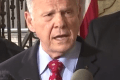
 MONTGOMERY (CFP) — Former Alabama Chief Justice Roy Moore will try again in 2020 to get elected to the U.S. Senate, three years after his campaign for the same office imploded amid sexual misconduct allegations — and despite a Twitter plea from President Donald Trump to stay out of the race.
“Can I win? Yes, I can win. Not only can I, they know I can. That’s why there’s such opposition,” Moore said at his June 20 announcement, referring to Republican leaders who will now face the headache of dealing with Moore in the GOP primary as they try to reclaim the seat from Democratic U.S. Senator Doug Jones.

Roy Moore announces Senate run in Montgomery (WKRG via YouTube)
“Why does the mere mention of my name cause people just to get up in arms in Washington, D.C.?” Moore said. “Is it because I believe in God and marriage and in morality in our country, that I believe in the right of a baby in the womb to have a life? Are these things embarrassing to you?”
Moore’s candidacy is being opposed by the National Republican Senatorial Committee, the campaign arm of GOP senators, as well as Senate Majority Leader Mitch McConnell and Alabama’s Republican U.S. Senator, Richard Shelby.
But it is the opposition of Trump — hugely popular in the Yellowhammer State — that may be the most formidable Republican obstacle in Moore’s path.
In a May 29 tweet, as speculation swirled that Moore might run, Trump said, “If Alabama does not elect a Republican to the Senate in 2020, many of the incredible gains that we have made during my Presidency may be lost, including our Pro-Life victories. Roy Moore cannot win, and the consequences will be devastating.”
Asked about the president’s opposition during his campaign announcement, Moore reiterated his support for Trump’s agenda and said he believed the president was being pressured to come out against him.
“I think President Trump has every right to voice his opinion. I think he’s being pushed by the NRSC,” Moore said.
Moore, 72, once again denied allegations made by five women that he pursued them sexually when they were teenagers in the 1970s — allegations that proved devastating to his 2017 campaign against Jones.
“I’ve taken a lie-detector test. I’ve take a polygraph test. I’ve done everything I could do,” he said.
Moore also said Jones’s win in 2017 — the first by a Democrat in an Alabama Senate race in 25 years — was “fraudulent” because he was the victim of a “false flag operation using Russian tactics.”
In late 2018, several news organizations reported that a group financed by a Democratic operative used Twitter and Facebook to spread disinformation against Moore, who lost to Jones by just 1 percent of the vote.
Jones, who has said he was not aware of what the group was doing, repudiated what he termed “deceptive tactics” and called for a federal investigation.
In his 2020 announcement, Moore said he suspected “Republican collusion” in the Democratic disinformation campaign, although he didn’t offer specifics.
Moore will be running in the Republican primary against a field that already includes U.S. Rep. Bradley Byrne of Mobile, former Auburn University football coach Tommy Tuberville, Secretary of State John Merrill from Tuscaloosa, and State Rep. Arnold Mooney from suburban Birmingham.
The two top vote getters in the March 2020 primary will advance to a runoff.
The challenge for the NRSC and Senate Republican leaders will be finding a way to work against Moore while remaining neutral among the other candidates. In 2017, their open support of Luther Strange backfired when Moore turned his ties with the Washington establishment into a potent campaign issue.
Moore first gained national notoriety as a local judge in 1995 after battling the ACLU over his practice of opening court sessions with a prayer and hanging the Ten Commandments in his courtroom.
He parlayed that prominence into election as Alabama’s chief justice in 2000 but was forced out in 2003 after he had a display of the Ten Commandments installed in the rotunda of the state judicial building and then defied a federal judge’s order to remove it.
Moore was once again elected chief justice in 2012, but in 2016, he was suspended by a judicial disciplinary panel for the rest of his term for ethics violations after telling local officials that they didn’t have to comply with the U.S. Supreme Court decision legalizing same-sex marriage.
After losing an appeal of his suspension, Moore resigned from the Supreme Court to run for the Senate vacancy created when Jeff Sessions resigned to become Trump’s attorney general.
In 2017, Moore was able to use his base of support from his tenure as chief justice to get into the runoff, where he defeated Strange, who had been appointed to the seat temporarily by disgraced former Governor Robert Bentley.
Trump had backed Strange in the runoff but quickly got on board with Moore once he won. But after the sexual misconduct allegations surfaced, McConnell, Shelby and other Republican Senate leaders abandoned their wounded nominee, even announcing that they would expel him from the Senate if he won.
Jones, who now faces the formidable challenge of trying to hang on to his Senate seat in deep red Alabama, is considered to be the most vulnerable Democratic incumbent in the Senate in 2020.
Jones greeted Moore’s announcement with a tweet: “So it looks like my opponent will either be extremist Roy Moore or an extremist handpicked by Mitch McConnell to be part of his legislative graveyard team. Let’s get to work so we can get things done!”
We tweet @ChkFriPolitics Join us!
Donald Trump kicks off 2020 re-election with mass rally in Orlando
Trump touts economic growth, hits Democrats for socialism, calls Russia investigation “great illegal witch hunt”
♦By Rich Shumate, ChickenFriedPolitics.com editor
 ORLANDO (CFP) — To shouts of “Four More Years” and “Build The Wall” from an exuberant capacity crowd, President Donald Trump formally kicked off his 2020 re-election campaign Tuesday night with a stem-winding speech in the key swing state of Florida.
“We did it once, and we’re going to do it again,” Trump told the crowd at the Amway Center in Orlando, many of whom had waited hours in the summer sun and braved thunderstorms for the chance to get inside. “And this time, we’re going to finish the job.”
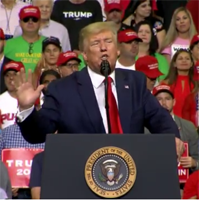
President Donald Trump addresses his campaign kickoff rally in Orlando on June 18 (YouTube)
“I have news for Democrats who want to take us back to the bitter failure and betrayals of the past. We are not going back.”
The president also unveiled the new tagline for his 2020 campaign: “Keep America Great,” building on 2016’s theme of “Make America Great Again.”
During his hour-long speech, Trump touted the nation’s robust economy, lower unemployment, tax cuts and appointment of conservative judges as evidence of his administration’s accomplishments.
But he also spent the first part of his speech relitigating the Russia investigation, which he called a “great illegal witch hunt” designed to overturn the results of 2016 election.
“No president should ever have to go through this again. It’s so bad for our country,” he said. “No collusion, no obstruction. And they spent $40 million on this witch hunt.”
The president largely avoided mentioning his potential 2020 Democratic opponents by name in his speech, except for a single reference each to “Sleepy Joe” Biden and “Crazy Bernie” Sanders.
However, in a likely preview of next year”s campaign, he offered biting criticism of the Democratic Party, which he said had embraced socialism and was “more radical, more dangerous and more unhinged than at any point in the history of our country.”
“America will never be a socialist country. Ever,” he said. “Republicans don’t believe in socialism. We believe in freedom, and so do you.”
Trump also blamed Democrats for what he termed “illegal mass migration” and accused them of “moral cowardice” for being unwilling to fix an immigration system that he branded as a “disgrace.”
The president also leaned in on his hard-line trade policy that has drawn criticism even from some Republican members of Congress, insisting tariffs have revived the American steel industry and let China know that “the days of stealing American jobs … are over.”
Fans of the president began lining up outside the Amway Center, which seats 20,000 people, some 40 hours before the speech began.
Trump told the crowd that 120,000 people had requested tickets for the rally, which marked an unusually early campaign kickoff for an incumbent president.
The president carried Florida in 2016 on his way to winning the Electoral College, and the Sunshine State will again be a state he’ll need to secure a second term.
Orlando sits in the I-4 corridor, a swath of Central Florida that often plays decisive roles in statewide elections.
We tweet @ChkFriPolitics Join us!

Poll showing Biden with a lead over Trump in Texas is not what it seems
Media reports of Quinnipiac poll overstate possibility that Trump is in trouble in the Lone Star State
♦By Rich Shumate, ChickenFriedPolitics.com editor
 AUSTIN (CFP) — Media organizations have been trumpeting results of a new poll that purports to show President Donald Trump trailing former Vice President Joe Biden in Texas — a somewhat shocking result, given that a Democrat hasn’t carried the Lone Star State since 1976 and hasn’t been close since 1996.
But a closer look at the numbers of the Quinnipiac Poll show that, from a purely statistical perspective, those reports may be misleading.
The poll, released June 5, found Biden leading Trump by a margin of 48-44 percent among registered voters in Texas, with a margin of error of plus or minus 3.4 percent.
What that margin of error means is that Biden’s actual support among registered voters in Texas could be as high as 51.4 percent or as low as 44.6 percent; Trump’s actual support could be as high as 47.4 percent or as low as 40.6 percent.
Because those two intervals overlap, it is statistically possible that Trump is actually ahead, as the high end of his support is above the low end of Biden’s support. So although it is probable that Biden has a lead, because the range of his support is higher, the poll does not absolutely establish a lead for Biden.
In order to establish with statistical certainty that Biden is leading Trump, his lead would need to be at least 6.8 percent, or double the margin of error.
The poll’s results for hypothetical match-ups of Trump with other Democratic 2020 contenders are even more muddled because neither candidate has a lead larger than the margin of error, which means that no one can even be said to even probably be ahead.
The poll results do, however, indicate that at this early stage of the race, the battle for Texas is closer that what might be expected and Biden appears to be performing more strongly against Trump than other 2020 competitors, including two Texans, former U.S. Rep. Beto O’Rourke and former San Antonio Mayor Julián Castro.
In 2016, Trump carried Texas by more than 800,000 votes, a margin of 9 points.
The Quinnipiac poll did turn up one result well beyond the margin of error — 60 percent of Texas don’t want to see Trump impeached, while only 34 percent do.
We tweet @ChkFriPolitics Join us!
Former Mississippi U.S. Senator Thad Cochran dies at 81
Cochran, the state’s first Republican senator since Reconstruction, served 45 years in Congress
♦By Rich Shumate, ChickenFriedPolitics.com editor
 OXFORD, Mississippi (CFP) — Former U.S. Senator Thad Cochran, who became one of Mississippi’s most revered statesmen in a political career that spanned nine presidents, has died. He was 81.
Cochran died May 30 at a nursing home in Oxford. His death was announced by the office of his successor, U.S. Senator Cindy Hyde-Smith. His daughter, Kate, told the Washington Post that the cause of death was renal failure.
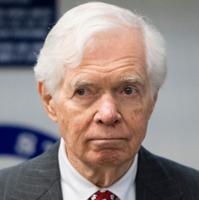
Former U.S. Senator Thad Cochran
Cochran retired in April 2018 because of ongoing health issues that had kept him away from the Senate for several months.
A funeral service will be held Monday at 11 a.m. at the State Capitol in Jackson. A second service will follow Tuesday at the Northminster Baptist Church in Jackson at 11 a.m.
Tributes for the late senator began pouring upon news of his death.
U.S. Senator Roger Wicker, who sat alongside Cochran representing Mississippi for a decade, said he “was a giant in the United States Senate and one of the greatest champions Mississippi has ever known.”
“When Thad Cochran left the Senate, I was reminded of Henry Wadsworth Longfellow, who wrote, ‘Lives of great men all remind us we can make our lives sublime, and departing leave behind us footprints on the sands of time,'” Wicker said. “Thad Cochran’s footprints are all around us
“Mississippi and our nation have lost a true statesman in Thad Cochran,” said Governor Phil Bryant. “He was a legend in the United States Senate where he worked tirelessly to move his state and country forward.”
President Donald Trump expressed condolences on Twitter: “Very sad to hear the news on the passing of my friend, Senator Thad Cochran. He was a real Senator with incredible values – even flew back to Senate from Mississippi for important Healthcare Vote when he was desperately ill. Thad never let our Country (or me) down!”
Cochran was born in 1937 in Pontotoc, a small town in the state’s northeast corner. After graduating from Ole Miss in 1959, he served two years in the Navy before returning home to finish law school and begin practicing law in Jackson.
His first foray into politics came in the 1968 presidential race, when he became state chairman for Richard Nixon’s campaign. At the time, the Republican Party was virtually non-existent in Mississippi, and segregationist George Wallace would bury Nixon. But four years later, Cochran would be elected to Congress on Nixon’s coattails as a Republican.
Cochran served three terms in the House before being elected to the Senate in 1978, becoming the first Republican since Reconstruction to represent the Magnolia State in the Senate.
During his time in the Senate, Cochran chaired both the agriculture and appropriations committees, positions that allowed him to funnel billions of dollars in federal money to projects back home, earning him the nickname “King of Pork.”
Cochran routinely won re-election without breaking a sweat until 2014, when he was challenged in the Republican primary by State Senator Chris McDaniel, who tried to rally Tea Party support to dislodge Cochran.
McDaniel forced Cochran into a primary runoff, which is when the good will and political capital the senator had banked during his long career paid off — he narrowly beat McDaniel after encouraging Democratic voters, including African Americans and farmers, to cross over and vote for him in the runoff.
That campaign became extremely contentious, particularly after a McDaniel supporter sneaked into a nursing home to shoot video of Cochran’s late wife, Rose, who was suffering from dementia, which was part of a gambit to accuse the senator of having an improper relationship with an aide.
The hard feelings remained in 2018, when McDaniel ran to succeed Cochran and the Republican establishment pulled out all the stops for Hyde-Smith, who beat McDaniel easily.
Rose Cochran died in 2014. In 2015, the senator married Kay Webber, a longtime aide.
Cochran is survived by his wife, two children and three grandchildren.

